Science Corporation, the neural engineering and brain-computer interface (BCI) company, today announced long-term (36 months) followup data from its pivotal PRIMAvera clinical trial (NCT04676854). The results were presented in a late-breaking session at the 26th EURETINA Congress of European retina specialists in Vienna by Mahi Muqit, MD, PhD, Consultant Vitreoretinal Surgeon at Moorfields Eye Hospital NHS Foundation Trust and Associate Professor at the Institute of Ophthalmology, University College London.
This press release features multimedia. View the full release here: https://www.businesswire.com/news/home/20261005144492/en/
Credit: Science Corporation
The PRIMA device, commercially available in Europe and the United Kingdom and pending FDA approval in the United States, is designed to use a tiny implant and special pair of glasses to replicate the function of light-sensitive cells in the eye that have been lost. It is indicated for patients suffering from geographic atrophy (GA) due to age-related macular degeneration (AMD), a leading cause of blindness affecting hundreds of thousands of people, typically over 60 years old. The results of the original PRIMA study were published in the New England Journal of Medicine [link].
“This is the first multi-year durability data for a BCI that restores form vision,” said Max Hodak, co-founder and CEO of Science. “In clinical trials, PRIMA is working better at month 36 than it did at month six.”
“Three years after implantation, the patients who gained vision have kept it, even improved it,” said Dr. Muqit. “The complications we saw were expected risks with subretinal surgery, they happened in the first weeks, and nothing new emerged across three years of follow-up.”
Study Highlights
These 36-month results extend the pivotal PRIMA clinical trial. The multi-center trial implanted 38 patients across 17 clinical sites in five European countries. At 36 months, 27 patients were evaluable for safety and 18 for efficacy.
The follow-up results include:
- No new safety signal emerged between 12 and 36 months. Serious adverse events were concentrated in the first six months after surgery; three occurred after month 12, and none were attributed to the device alone.
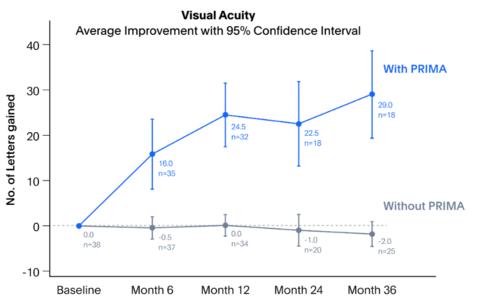
- Mean improvement of 29 letters (nearly 6 lines) on ETDRS letter chart at 36 months, greater than the 24.5 letters measured at 12 months.
- 78% of patients assessed achieved prosthetic visual acuity improvements of at least logMAR 0.3 (equivalent to 15 letters on ETDRS chart) at 36 months (n=14 of 18).
- Existing natural vision in the implanted eye remained stable through 36 months, with serial imaging showing anatomic stability at the implant site.
How It Works
The PRIMA implant is a novel subretinal photovoltaic implant paired with specialized glasses that project near-infrared light to the implant. A zoom feature provides patients with the ability to magnify letters. The implant rests within the atrophied area of the retina and measures 2mm x 2mm x 30µm.
GA is characterized by a loss of photoreceptors in the retina. PRIMA combats this loss with its wireless subretinal implant that operates as an array of artificial photoreceptors, stimulating the remaining cells to carry the visual signal to the brain. Unlike conventional therapies that attempt to slow disease progression, PRIMA has been shown in clinical trials to directly restore lost functional vision in GA patients.
Millions of people have AMD; this generation of PRIMA is designed for a subset with advanced GA where vision loss is severe. PRIMA was originally developed by Professor Daniel Palanker at Stanford University. Science Corporation manufactures the current version and is designing the next version of the implant with improved visual resolution and field of view, to bring this technology to more patients.
About Science
Science Corporation is a vertically integrated, full-stack neural engineering company. Our mission is to restore and extend life by transcending the limits of biology. Our first commercially available product is the PRIMA implant for blindness caused by geographic atrophy in patients with age-related macular degeneration. We are developing other advanced brain-computer interface technologies and devices to address critical unmet medical needs and, longer term, to transform the human condition through neural engineering and advanced perfusion technology. Science is headquartered in Alameda, California, with offices in Paris, France. For more information, please visit: www.science.xyz.
View source version on businesswire.com: https://www.businesswire.com/news/home/20261005144492/en/
Media gallery